Written by the team at KCs Plumbing, Heating & Drain Services · Reviewed by Jack Japuncic, Master Plumber
The Best Time to Replace Your Water Heater...
Eight years. Twelve years. Somewhere in between, most tanks start dropping hints, a little less hot water than last winter, a faint rust tinge, a noise you don't remember hearing before. None of it is an emergency yet, which is exactly why it's easy to ignore. The homeowners who end up happiest with the outcome are the ones who read those hints early enough to choose, rather than waking up to a cold shower or a flooded utility closet and having the choice made for them.
How Long Does a Hot Water Tank Last?
A conventional tank water heater typically lasts around 8 to 12 years. Some reach the higher end of that range with good care, and some fall short of it through neglect or hard use. Age alone isn't a death sentence, but once a tank passes the decade mark, the odds shift. Repairs become less worthwhile, efficiency drops, and the risk of a leak climbs. Knowing your tank's age is the single most useful piece of information you can have, so if there's an install date on the unit or in your records, it's worth finding.
The Warning Signs Your Tank Is Failing
Tanks usually give you hints before they quit. Here's what each one is actually telling you:
- Rusty or discoloured hot water. This often means the tank is corroding internally. Once rust appears in your hot water, the tank is frequently nearing the end.
- Not enough hot water, or it runs out fast. Sediment building up at the bottom of the tank steals capacity and forces the unit to work harder, a common sign of an aging tank.
- Rumbling, popping, or banging during heating. That's hardened sediment. It signals lost efficiency and a tank that's been working too hard for too long.
- Water around the base. A leak from the tank body itself cannot be repaired, and it only gets worse.
If your tank is leaking, treat it as urgent.
- Repeated repairs. When the repair bills start adding up on an older unit, you're usually delaying an inevitable replacement.
One or two of these on a young, well-maintained tank may just call for a
repair. Several of them on a tank past its prime is your answer.
Repair or Replace? How to Think About the Decision
As a rough rule, a single failed part on a young tank favors repair, while an aging or leaking tank usually doesn't. For the full breakdown of what's repairable and what isn't, see our guide on
water heater repair.
A Quick Reference
What You're Seeing
- Single failed part (thermostat, element, valve)
- Rusty or discoloured water
- Leak from the tank body
- Rumbling or reduced hot water
- Multiple repairs in the past year
Tank Under 8 Years Old
- Repair
- Flush and inspect (may be the anode rod)
- Replace
Tank Over 8 Years Old
- Repair, unless other signs are also present
- Likely replace
- Repair or replace, depending on severity
The above suggestions are a starting point, not a diagnosis. A quick inspection settles it for your specific tank.
A Local Wrinkle: Why Tanks Here Don't Fail the Way the Manual Predicts
Most manufacturer lifespan estimates are written for hard-water regions, and ours isn't one. Water pulled from the Capilano, Seymour, and Coquitlam reservoirs runs low in dissolved minerals, so the scale buildup that chokes a tank's efficiency elsewhere is a smaller factor here. That sounds like a pure win, and mostly it is, except that soft low-mineral water is more corrosive toward the
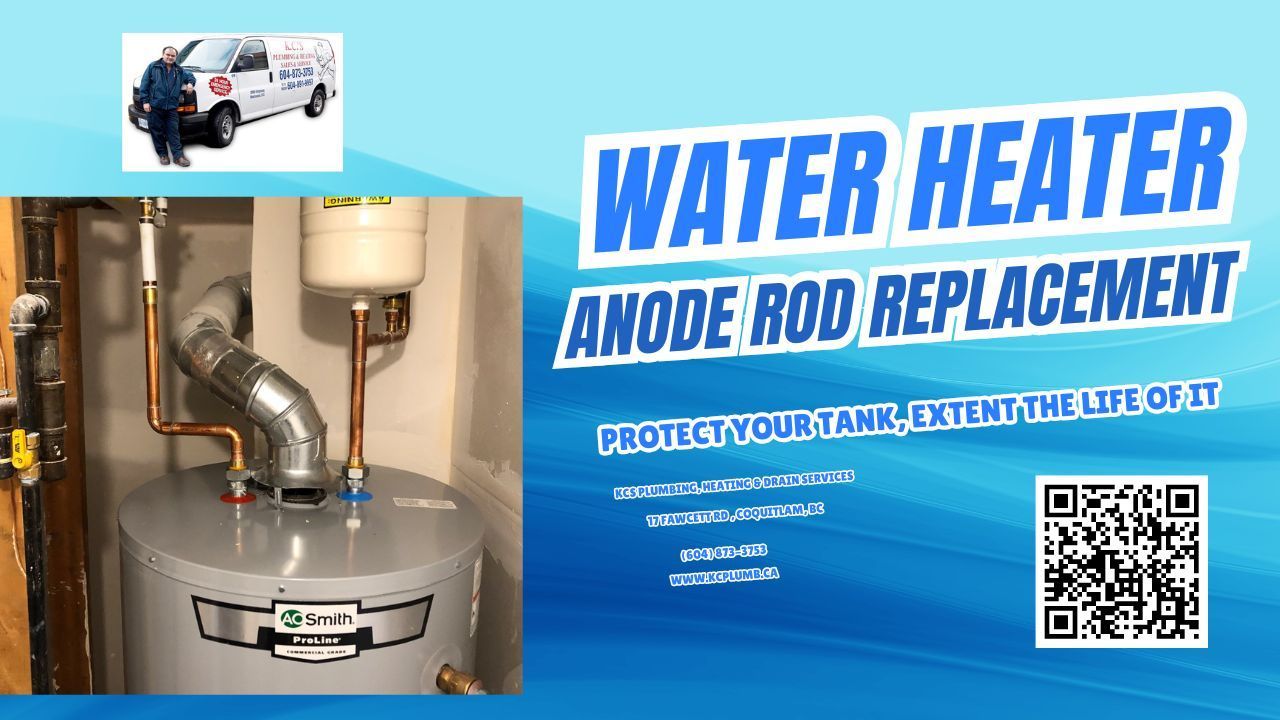
anode rod, the sacrificial metal core that exists specifically to rust instead of your tank's steel walls. A tank that's coasting on a neglected anode rod can go from "fine" to "leaking" faster than the age-based estimate suggests. It's the one part of this equation that's easy to miss, and the one most worth a quick check if your tank is past year six.
What Size Replacement Tank Do You Actually Need?
Getting the size right matters more than most homeowners expect. Too small, and you're back to cold showers during busy mornings. Too large, and you're paying to heat water you never use.
Tank size comes down to two things: how many people live in the home, and how they use hot water. A single person or couple in a condo usually does fine with a 40 gallon tank. A family of four to five typically needs 50 gallons. Larger households, or homes with a soaker tub and multiple bathrooms running at once, often call for 60 gallons or more.
Recovery rate matters too. That's how fast the tank reheats water after it's used. A gas tank recovers faster than an electric one of the same size, which is worth knowing if your household runs hot water back to back rather than spread through the day.
The safest way to get this right is a quick assessment of your household size, fixture count, and habits, rather than guessing or matching whatever size was already there. Homes change over the years. The tank that fit a young couple may not fit the same house fifteen years later with three kids and a bigger shower.
Gas, Electric, or Heat Pump: Which Replacement Makes Sense?
Most Lower Mainland homes already have a fuel type locked in by their existing hookups, and matching it is usually the simpler, cheaper path. But a replacement is also the natural moment to reconsider, since you're already paying for labour either way.
Gas tanks heat water faster and tend to cost less to run where natural gas is available. They need proper venting and a licensed gas fitter for any work, which is a legal requirement in BC, not just a good idea.
Electric tanks are simpler to install where gas isn't already run to the home, and they skip the venting requirement entirely. Running costs depend on your local electricity rates.
Heat pump water heaters are the newer option worth a look. They use a fraction of the electricity a standard electric tank does, because they move heat from the surrounding air rather than generating it directly. The tradeoff is a higher upfront cost and a larger footprint, since they need airflow around the unit to work efficiently. For the right home, the running-cost savings make up the difference over time.
Switching fuel types during a replacement, for example moving from gas to a heat pump unit, is more involved than a like-for-like swap. It's still worth asking about if efficiency and long-term cost matter to you.
What to Expect When You Replace Your Tank
If you decide it's time, knowing what a proper replacement involves takes a lot of the worry out of it. A good installer assesses your home and sizes the new tank correctly, safely disconnects and drains the old unit, removes and disposes of it, installs the new tank to code with proper venting and a correctly rated relief valve, adds a thermal expansion tank if your system requires one, and tests everything before leaving. In BC, replacing a gas tank legally requires a licensed gas fitter and a permit, which is there to protect you from gas and carbon monoxide risks. When you're ready for that step, our
hot water tank replacement service walks you through all of it.
What Happens to Your Old Tank?
A responsible replacement includes taking the old unit away, not leaving it in your driveway to deal with. Old hot water tanks are mostly steel, which makes them scrap-metal recyclable rather than landfill waste. A properly disposed tank gets drained, the water and any remaining sediment handled safely, then recycled through a metal recycler rather than thrown out whole.
This is worth confirming with whoever you hire. Removal and responsible disposal should be part of the replacement, not a separate charge or a task left to you.
Are There Rebates for Replacing a Hot Water Tank in BC?
Possibly, depending on what you're replacing your tank with. Provincial and utility rebate programs in BC, through CleanBC, BC Hydro, and FortisBC, periodically offer incentives for high-efficiency replacements, particularly heat pump water heaters. Standard gas and electric resistance tanks are generally not eligible under current programs, though this has shifted before and can shift again.
These programs change often enough that quoting a specific dollar amount here would likely be out of date by the time you read it. The reliable way to check what applies to your specific replacement is directly through
CleanBC's current program page or by asking us when we quote the job. We'll flag if your planned replacement qualifies for anything worth applying for.
Planning Ahead Beats an Emergency
Here's a quiet truth worth sharing. The best time to replace a tank is usually just before it fails, not the morning you wake up to a cold house or a flooded floor. A planned replacement lets you choose the right unit, schedule at your convenience, and avoid the water damage and stress of an emergency. If your tank is in that grey zone, getting older but not yet failed, it's worth having it looked at so you can plan rather than react.
Frequently Asked Questions
How Do I Know if My Hot Water Tank Needs Replacing?
The clearest signs are age past 8 to 12 years, rusty hot water, water pooling at the base, running out of hot water quickly, and rumbling noises. Several of these together usually mean it's time.
Should I Repair or Replace My Hot Water Tank?
Repair usually makes sense for a young tank with a single failed part. Replacement is the better investment for a tank that's past its lifespan, leaking from the body, or repaired repeatedly.
Does Our Soft Water Really Affect How Long a Tank Lasts?
Yes, but not the way most people expect. It reduces scale buildup, which is good, but it wears down the anode rod faster, which is the part that actually needs watching in this region.
Is It Better to Replace a Tank Before It Fails?
Generally, yes. A planned replacement lets you choose the right unit and avoid the water damage, cost, and stress of an emergency failure.
https://i9.ytimg.com/vi_webp/67ykorPX5A0/mqdefault.webp?v=6a271e95&sqp=CJCxjNQG&rs=AOn4CLCz8XcHx5ans6vjO4RqZCs5Ib6N_A
Still Not Sure? Let's Take a Look
If you're weighing whether your tank has life left or it's time for a new one, you don't have to guess. The team at KCs Plumbing & Heating will give you an honest assessment, repair when that's the right call, and handle a full replacement when it isn't, backed by a comprehensive warranty and more than 30 years serving Lower Mainland homes and businesses.
Call KCs Plumbing & Heating at
(604) 873-3753 or
request service online. We're here when you need us, including evenings, weekends, and emergencies.